TL;DR
“UK hosted” only tells you where data physically sits, not who controls the company, who runs the infrastructure, or which jurisdiction applies. Two different buyers — one needing compliance, one wanting a British company and native English support — get short-changed by the same phrase. Andy McGurk sets out four questions that settle it, and explains why a data centre’s postcode answers almost none of them.
A procurement lead at a mid-sized building society — around 900 staff, the sort of organisation that takes the word “regulated” seriously because the FCA takes it seriously about them — sent me a shortlist of hosting providers a few weeks ago and asked which one was “properly British”.
Every one of them had “UK hosted” somewhere near the top of the page. Two had a little flag. One had a photograph of a data centre that, on closer inspection, was a stock image of a data centre that could have been anywhere with a cooling system and a floor.
She wasn’t being naive. She was doing the exact thing the marketing had trained her to do, which is to read “UK hosted” as though it were a certification rather than a piece of geography.
It isn’t. And the gap between what those two words say and what people hear them say is one of the more expensive misunderstandings in enterprise infrastructure at the moment.
Part of what makes it expensive is that two completely different buyers are reaching for the same phrase, and it means something different to each of them.
Two people buy “UK hosted” and they are not buying the same thing
One buyer is the procurement lead above. For her, “UK hosted” is a compliance question. She needs to know that data stays under UK jurisdiction, that a legal request from another country can’t quietly reach into her platform, that the answers she gives an auditor are true in the contract and not just on the pricing page. For her, the phrase is either load-bearing or it’s a liability.
The other buyer wants something more human and, I’d argue, just as legitimate. They want to spend their money with a British company because they’d rather the corporation tax and the payroll and the jobs stay in the UK economy than disappear into a holding structure three jurisdictions away. And they want, when something breaks at nine on a Tuesday morning, to talk to somebody in the same timezone who speaks their language fluently and can actually fix the thing rather than read them a script.
Those are different purchases. The first is about risk. The second is about where your money lands and whether the person on the other end of the ticket can help you. The marketing deliberately smears them together into one flag, because one flag is cheaper than answering both properly.
Let me take them one at a time, because “UK hosted” fails each buyer in its own specific way.
Where your data sleeps is not the same as who holds the keys
For the compliance buyer, “UK hosted” is a claim about location and nothing more. It tells you data is sitting, physically, on disks in a building somewhere in the United Kingdom. That’s real, and for data residency — the narrow question of where information geographically lives — it’s more or less the whole answer.
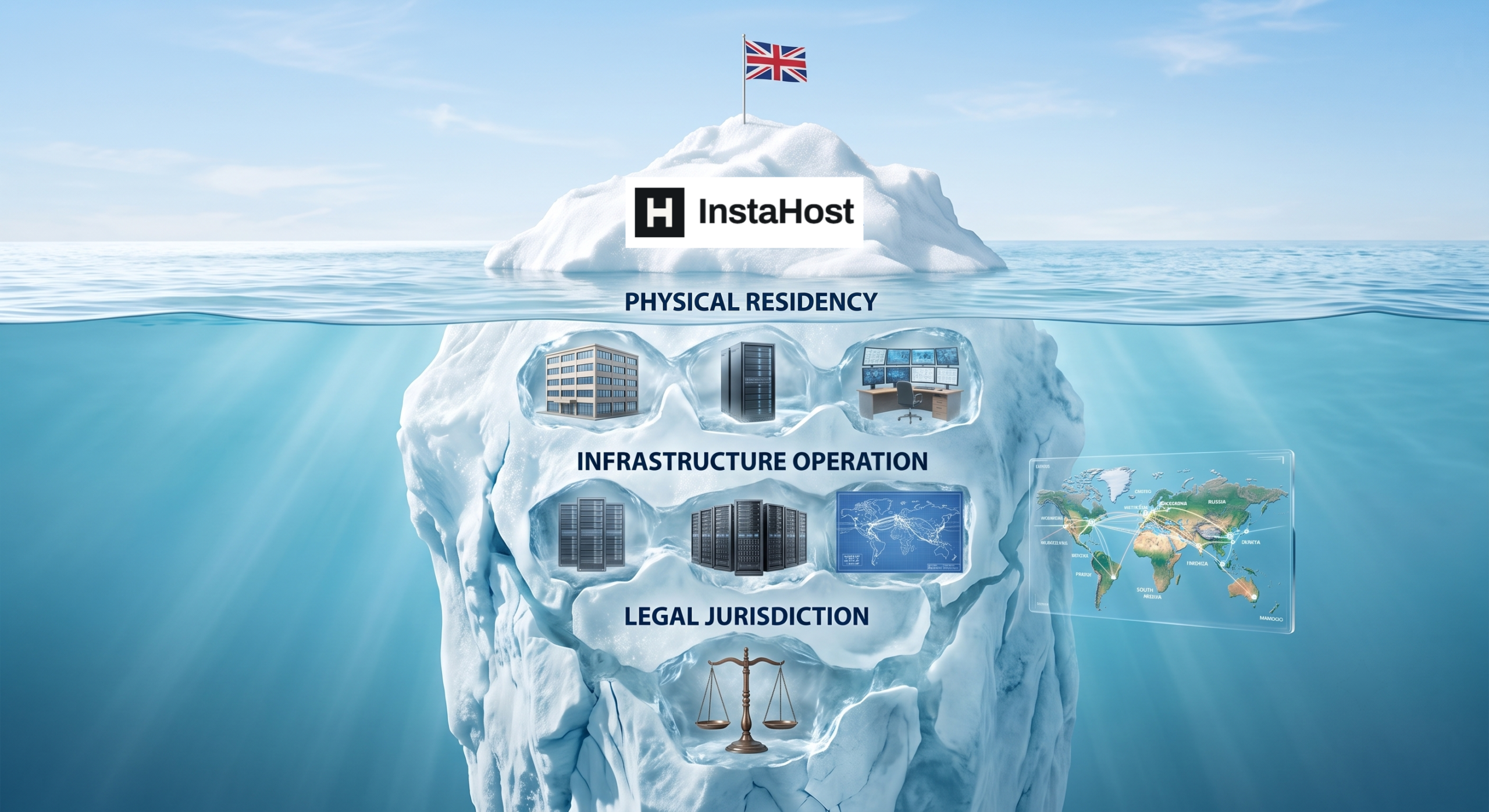
What it does not tell you is who operates the platform, which company’s jurisdiction the provider actually falls under, or how the infrastructure underneath is assembled. Those are separate layers, and they come apart more often than the marketing would like you to notice. Layershift made this point well in a piece back in April, and it’s worth repeating because almost nobody selling to you wants it repeated: location describes where the data is, not who controls it.
The version that catches people is this. A service can be hosted in a UK data centre and operated by a company headquartered somewhere else. The bytes are in Slough. The control plane, the corporate parent and the legal obligations are abroad. Your data is UK-resident and simultaneously exposed to a foreign legal framework, and the word “hosted” carried none of that.
The reverse trap is subtler. A provider can be a genuine UK company and still build its whole platform on top of a US hyperscaler, which means when the hyperscaler changes its terms, its pricing or its willingness to serve a particular customer, the “UK” provider is a passenger. British in name. Dependent in fact.
The bit the economy-minded buyer and the support-minded buyer actually care about
Here’s where the second buyer gets short-changed, and it’s a quieter disappointment because it doesn’t show up in an audit. It shows up on a Tuesday.
Buying British, if that’s your reason, means buying from a company that is actually British — owned here, controlled here, paying its taxes here, employing people here. A firm can slap “UK hosted” on the site while being a reselling front end for infrastructure and a support desk that both sit somewhere else entirely. Your money is nominally going to a British website and substantially going abroad. If supporting the UK economy is the point, “UK hosted” is precisely the wrong thing to check, because it describes a data centre’s postcode, not a company’s tax residence or its payroll.
And then there’s support, which is where the disappointment usually lands first, before anyone’s read a single clause. Plenty of buyers choose a “UK” provider specifically so that the person answering the ticket is in the same timezone, speaks English as a first language, and can hold a normal conversation without either party working around a script. This isn’t snobbery about accents and I want to be careful here — the real issue is offshored, script-bound support where the agent has no authority to change anything and no context on your account, which tends to travel with outsourcing but is really a problem of distance and permission. When your site’s down, you don’t want a chatbot’s cousin reading you steps from a knowledge base article you’ve already found. You want someone who understands you the first time and can act. That’s a genuine product difference, and “UK hosted” doesn’t promise it, because a UK data centre can be supported from anywhere on earth.
The four questions that actually settle it
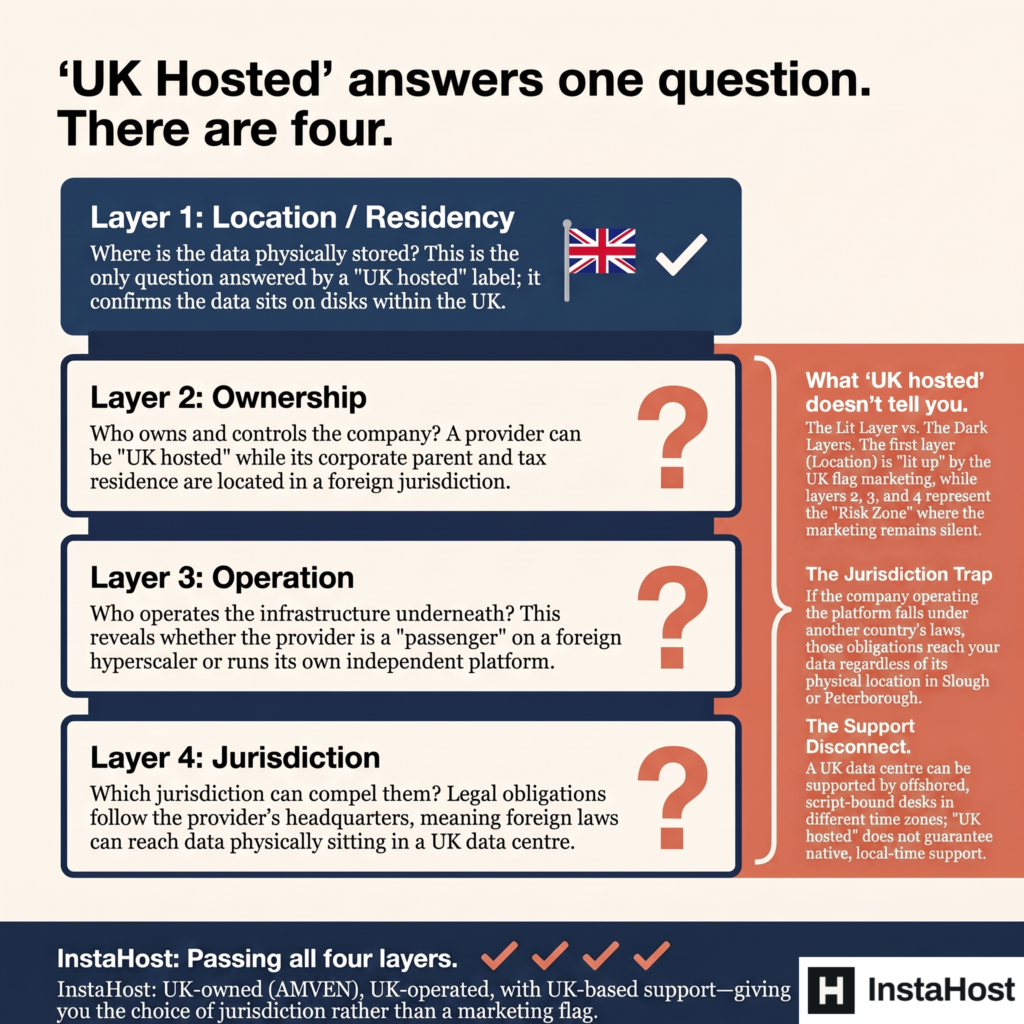
If you want to know what you’re really buying — whichever buyer you are — stop asking whether something is “UK hosted” and ask four separate questions instead. They aren’t the same question in four hats. Each can come back with a different answer, and the combination is your real exposure.
Where is the data physically stored. Who owns and controls the company you’re contracting with. Who operates the infrastructure underneath. And which jurisdiction can compel that company to act.
A provider can pass the first and fail the other three. That’s the common case, and it’s the one that gets a compliance officer a bad afternoon eighteen months into a contract — or, for the other buyer, the one that turns “I’m supporting a British business with British support staff” into “I’m on hold to a call centre eight timezones away, funding a balance sheet in Delaware.” The honest providers can answer all four without reaching for a flag. The ones who can only answer the first tend to answer it very loudly.
Where InstaHost actually sits, since it would be cowardly not to say
I should be straight about my own position, because writing this while running a hosting business and staying vague would be exactly the move I’ve just spent a thousand words objecting to.
InstaHost is a trading name of AMVEN, a UK-based and UK-controlled company. We’ve been hosting UK businesses since 1996, back when we were Amacsys Networks, and we still run from Peterborough. So the ownership answer to question two is simple, and I’ll give it without a caveat: the company you contract with is British, controlled from the UK, not sitting underneath a foreign parent. If your reason for buying British is that you want your money to stay in the British economy, that answer is the one that actually settles it, not the data centre postcode.
Our support team is in the UK too, which I mention not to boast but because it’s the point the previous section was about. When you raise a ticket, you’re talking to someone here, in your timezone, who can act.
The infrastructure answer is more interesting, and I’ll give you the honest version rather than the poster version. InstaHost runs servers in multiple countries. Our largest data centre and the bulk of our server estate are in the UK. But I’m not going to claim there isn’t a single disk of ours outside British soil, because that would be untrue, and untrue is the whole thing I’m complaining about.
What we do instead is hand the fourth question — jurisdiction — to you. When you provision with us, you choose which country your server sits in. If your requirement is that your data stays under UK jurisdiction, you select the UK, and it does, on infrastructure controlled by a UK company with UK support behind it. If your requirement is different, you make a different choice, on purpose, with the trade-off in front of you rather than buried in a data-processing addendum. Most “UK hosted” providers give you a flag and no choice. The choice is the honest product. The flag is the marketing.
Note
“UK hosted” is almost never a defined term in the contract you sign. It lives in the brochure and on the pricing page, rarely in the clause a court would read. Before you rely on it, check whether the provider has committed to UK control, ownership and support in the binding agreement — or only on the website a marketer wrote.
What a buyer should do this week
Three things, and they’re not the same size, because the middle one is where most of the risk lives.
First, work out which buyer you actually are — compliance, or economy-and-support, or both — and answer the four questions above about your current provider in writing, in four separate lines. If you can’t answer one, that gap is your homework, not a rounding error.
Second, and this is the one that matters most, read the actual contract for the phrase you’re relying on, because “UK hosted” is almost never a defined term in the agreement you’ve signed. It’s in the brochure. It’s on the pricing page. It’s rarely in the clause a court would read. Find out whether the provider has committed to UK control, UK ownership, and UK support in the document that binds them, or merely on the website a marketer wrote. Those are very different promises and only one survives contact with a legal request — or with a Tuesday-morning outage.
Third, raise a support ticket before you sign, not after. Ask a real question and see who answers, from where, in how long, and whether they can actually change something. You’ll learn more about a provider from one pre-sales ticket than from an entire page of flags.
The last word
“UK hosted” describes where the data sleeps. It doesn’t describe who owns the building, who can be made to open the door, where your money ends up, or who picks up when you call.
Those are four different questions, and the providers hoping you won’t ask the other three are precisely the ones you should be asking them of. A flag is not an answer. A choice is. And someone who understands you the first time is worth more than both.
Andy McGurk is the founder of AMVEN and InstaHost, has been hosting UK businesses since before “the cloud” was a marketing department, and remains quietly unconvinced by anyone who puts a flag on a pricing page.
Q: Does “UK hosted” mean the provider is a British company?
A: No. It only means data is stored in a UK data centre. A service can be hosted in Britain while the company operating it — and receiving your payment — is headquartered and taxed abroad. If your reason for buying British is to support the UK economy, ownership and tax residence are what matter, and “UK hosted” tells you neither. InstaHost, as a trading name of AMVEN, is a UK-based and UK-controlled company.
Q: Does UK hosting mean my data is only subject to UK law?
A: Not necessarily. Hosting in the UK settles where the data sits, but legal jurisdiction follows the provider. If the company operating the platform falls under another country’s laws, those obligations can still reach your data even though it’s physically in Britain. The question to ask is which jurisdiction can compel the provider to act — not simply where the disks are.
Q: Is my support team based in the UK if the hosting is “UK hosted”?
A: There’s no connection between the two. A UK data centre can be supported from anywhere on earth, and many “UK hosted” providers run offshored, script-bound support desks. If speaking to someone in your timezone who can actually resolve the issue matters to you, ask where support sits before you sign — ideally by raising a pre-sales ticket and seeing who answers. InstaHost’s support team is UK-based.
Choose where your servers live — and know who’s behind them
InstaHost is a trading name of AMVEN — UK-based, UK-controlled, UK-supported. Run servers in the UK or pick another jurisdiction on purpose, with the trade-off in front of you rather than buried in an addendum.
Explore InstaHost UK hosting